

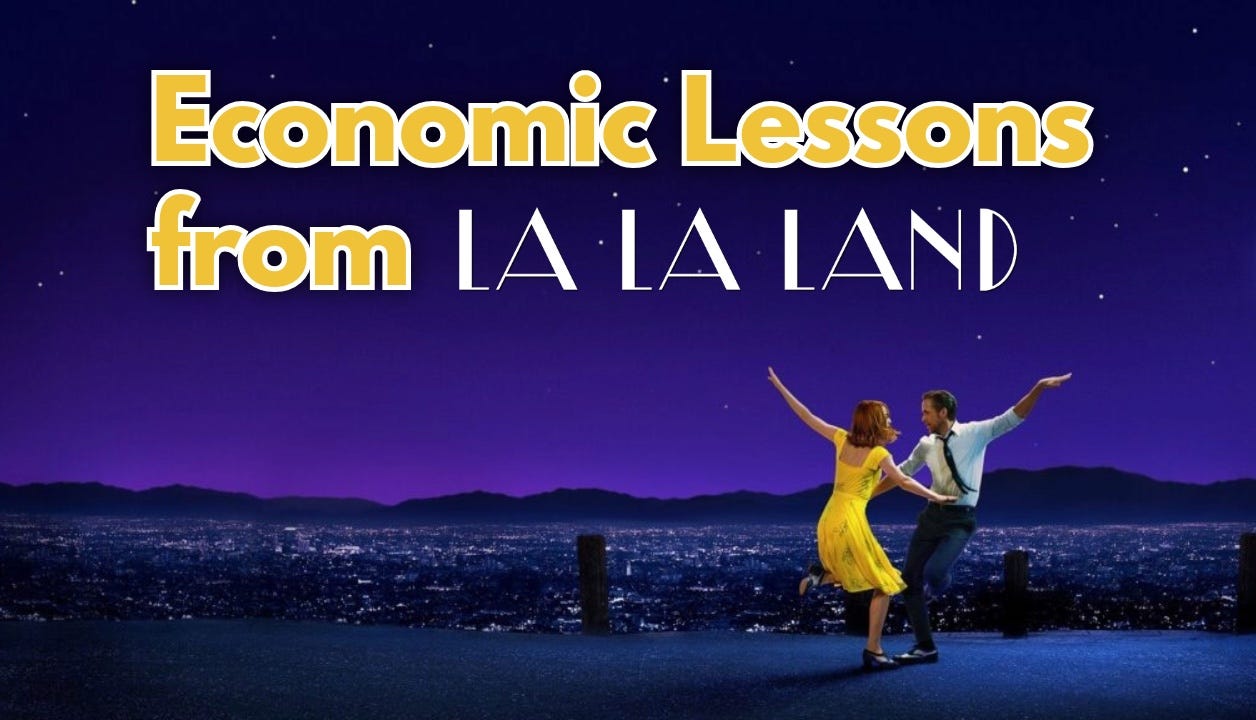
This year marks the ten-year anniversary of one of my favorite movies - and musicals - of this century, La La Land. It is also Oscar season and the nine-year anniversary of one of the most memorable moments in Oscar history: La La Land being mistakenly announced as the Best Picture winner before the award was ultimately given to Moonlight.
The moment was awkward and unforgettable—and oddly fitting for a movie about hope, uncertainty, and chasing improbable dreams.
But La La Land also offers something else that has aged remarkably well: some clear, intuitive economic lessons hidden inside its musical numbers.
Two songs in particular—Another Day of Sun and Someone in the Crowd—capture core ideas from economics.
Sunshine, Location, and Real Estate Prices
The film opens with Another Day of Sun, a joyful number set amid gridlocked traffic in Southern California. The singers aren’t living glamorous lives. They’re struggling, commuting, auditioning, and chasing long-shot dreams. Yet one theme keeps resurfacing: no matter how hard things get, at least the sun keeps shining.
From an economics perspective, this is a lesson about amenities and housing markets. All else equal, people prefer to live in places with pleasant weather. A great climate makes a location more desirable, increasing demand for housing in that area. When demand rises faster than supply—as it often does in dense or highly regulated cities—home prices and land values increase.
Sunshine doesn’t just make people happier; it gets capitalized into real estate prices. That helps explain why similar homes can cost dramatically more in Southern California than in places with harsher climates. Another Day of Sun captures this tradeoff perfectly: life may be hard, but the location itself is valuable.
Networking, Uncertainty, and Search Costs
Later in the film, Someone in the Crowd follows four aspiring actresses getting ready for a party. They’re exhausted, frustrated, and unsure—but hopeful that this might be the night they meet the right person. The song captures the strange mix of optimism and anxiety that defines many creative careers.
Economically, this is a vivid illustration of search costs. Search costs are the time, effort, and resources spent looking for opportunities. For workers, that includes auditions, networking events, unanswered emails, and informal conversations. For employers, it’s the challenge of identifying the right candidate among many qualified options.
High search costs explain why luck and timing play such a large role in careers—and why networking matters so much. Social connections can reduce search costs by speeding up the matching process. One conversation, one introduction, or one chance encounter can dramatically change someone’s trajectory. Someone in the Crowd is essentially a musical about imperfect information and the hope that one connection can make all the difference.
Why La La Land Works So Well for Economics
What makes La La Land especially useful for teaching economics is that it doesn’t romanticize outcomes—it highlights tradeoffs. Great weather comes with higher housing costs. Dream careers come with uncertainty and long searches. And even beyond the songs, we see economic forces at work with Sebastian, Mia, and the other characters throughout the movie.
Ten years later, La La Land remains a powerful reminder that economics considers how people respond to incentives, scarcity, uncertainty, and hope—even when they’re dancing on the freeway.