

Meta’s current value on the stock market is almost $2 trillion! How could this be the case when they, and other social media companies, charge users nothing to use.
We tend to associate economic value with prices. A house costs hundreds of thousands of dollars. A new car might cost $40,000. A cup of coffee costs $3, $5, or, increasingly, something higher that resembles a new car payment and makes one briefly question their life choices.
But most social media platforms have a price of exactly $0. But with billions of people using them every day, these social media companies have become some of the largest and most valuable businesses in the world.
So how does that happen? I explore that and much more in my most recent video.
A Price of Zero Doesn’t Mean a Value of Zero
Economists use the concept of consumer surplus to describe the difference between what someone is willing to pay for something and what they actually have to pay. Suppose you’d be willing to pay $5 for your morning coffee, but the coffee shop charges you $3. You’ve received $2 of consumer surplus.
Now think about social media.
If you pay nothing to use Instagram, for example, but receive substantial value from it, essentially all of that value represents consumer surplus. But how do we measure this value?
That is a question I’ve studied with several colleagues that culminated in an article we published in 2018.
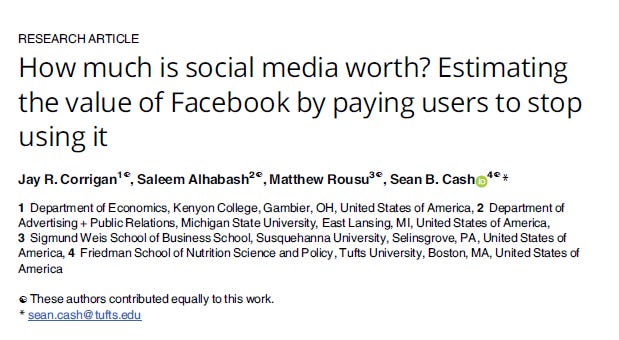
Jay, Sean, Saleem, and I conducted economic experiments in which participants had opportunities to receive real money in exchange for giving up Facebook for specified periods of time. How much did they need? A lot!!!
The average participant required more than $1,000 to give up Facebook for one year.
Other economists using somewhat different approaches have found similar evidence that people place substantial value on social media.
That doesn’t mean social media has no downsides. And it certainly doesn’t mean every hour spent scrolling is an hour well spent. But it does illustrate an important economic lesson: Something can be free and still be enormously valuable.
Traditional economic statistics have a particularly hard time capturing this. If a product becomes dramatically better but remains priced at zero, much of the increase in consumer welfare doesn’t show up in measures based on market transactions.
For more, watch the video
In the video, I also cover the economics of network effects, economies of scale, and the value of entrepreneurship to society. I hope you enjoy!