

One of the first lessons students learn in economics and game theory is that an equilibrium is a stable outcome. And yet, if you’ve watched Bridgerton Season 2, you know that stability is exactly what Anthony Bridgerton fails to achieve.
In this post (and accompanying video), we share the insights of my student Kayla Gaston who completed this for her game theory final project. (This is the second of two topics she covered. The first is here.)
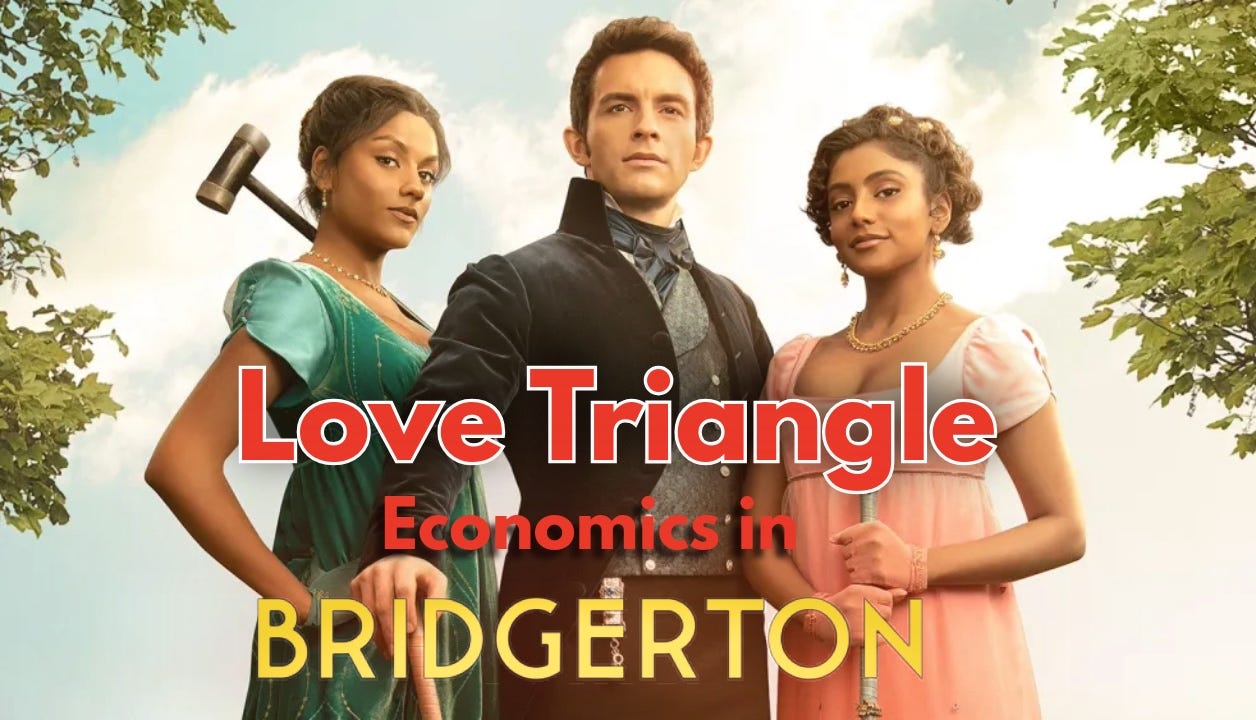
This season revolves around a love triangle between Anthony, Kate Sharma, and Edwina Sharma. On the surface, Anthony behaves exactly as a rational actor should. He wants a marriage that maximizes status, minimizes emotional risk, and secures the Bridgerton line. Love, he tells us repeatedly, is unnecessary—and possibly dangerous.
So why does everything collapse?
The Setup: A Seemingly Rational Game
Anthony enters the marriage market with a clear objective: find the best possible match. When the Sharma sisters arrive in London, Edwina quickly becomes the queen’s “diamond”—the most desirable option available. Kate, her older sister, is not seeking marriage and instead focuses on securing the best outcome for Edwina.
At this point, the incentives align neatly:
Anthony gets a socially optimal marriage
Edwina marries into nobility
Kate succeeds in her goal of protecting her sister
From a game-theory standpoint, this outcome is Pareto efficient: no one can be made better off without making someone else worse off. It’s also a Nash equilibrium—no single player has an incentive to deviate.
If this were a textbook problem, the game would end here.
But Bridgerton isn’t a textbook.
The Critical Decision: A Deviation from Equilibrium
Everything hinges on one moment: the wedding ceremony.
At the altar, Anthony faces a simple but consequential choice—ignore Kate or stare at her. Ignoring Kate preserves the equilibrium. Staring at her introduces new information into the game and fundamentally alters incentives for everyone involved.
In the video embedded below, Susquehanna University Game Theory student Kayla Gaston walks through this moment using a decision tree and payoff analysis:
Once Anthony deviates, Edwina must decide whether to proceed with the wedding or flee. Kate must decide whether to confess her feelings or reassure her sister. Each branch of the decision tree produces a different payoff—and many are significantly worse than the original equilibrium.
This is a classic game-theory lesson: even when a stable equilibrium exists, players don’t always choose it.
Why Rational Players Make “Irrational” Choices
From the outside, Anthony’s decision looks foolish. Ignoring Kate would have preserved his reputation, secured his title, and avoided public embarrassment.
So why doesn’t he do it?
Game theory doesn’t assume players are emotionless robots. It assumes players respond to incentives as they perceive them. Anthony overweights short-term emotional signals and underestimates long-term strategic costs. In doing so, he breaks a stable equilibrium and forces everyone else to respond.
This is precisely what makes Bridgerton such a useful teaching tool. The show demonstrates that:
Rational outcomes can exist without being chosen
Deviations often impose costs on others, not just the decision-maker
Emotional information can destabilize otherwise efficient games
In real life—whether in relationships, business, or politics—this happens all the time.
The Takeaway
Bridgerton Season 2 is not just a romance. It’s a case study in how strategic interaction breaks down when commitment falters and incentives shift.
Anthony’s tragedy isn’t that he lacks good options. It’s that he fails to commit to the one that makes everyone—including himself—better off.